By Yevhen Brokhin (aka Jæk Bryö), internationally acclaimed art-tech visionary and founder of Collab, creating phygital immersive experiences.
Public art shouldn’t be an architectural afterthought. It should be an integral layer of the built environment — emotional infrastructure that shapes how people feel, move, and connect. Public art is what differentiates a mere urban development from a true destination.
What if public art wasn’t decoration, but part of a city organism? Not a plaza ornament or a mural meant to “brighten up” a wall, but the emotional architecture of a city. Public art rewires how we experience space — it provokes, connects, and becomes the pulse. It’s the nervous system influencing how people move, feel, and belong. Real urban visionaries don’t build developments — they build life.
While Western planners debate the value of public art, Asian cities already treat it as civic infrastructure. One talks theory — the other builds it.
A Shanghai building features a kinetic façade made of three overlapping layers of vertical stainless-steel pipes that rotate every two hours for ten minutes, transforming the entire structure in real time.
Marina Bay Light Canvas (since 2017) in Singapore activated a previously dead transit atrium into a platform for collective engagement, proving how value can be generated through experience, not just square meters.
They show that artistic intelligence solves core urban problems: creating identity, activating underused spaces, and fostering community. These aren’t installations — they are urban assets.
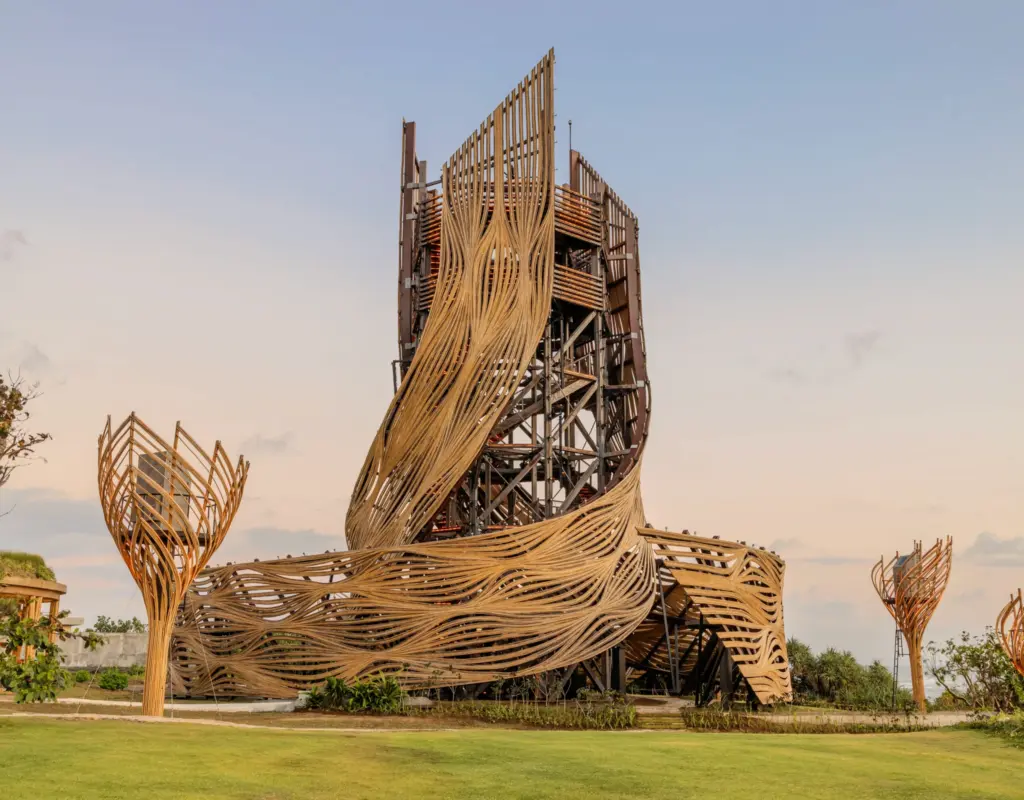
An even more interesting example of art infrastructure intertwined with the urban context is the Lighthouse – Tri Hita Karana Tower project, implemented by COLLAB – a company that brings brand spaces to life through immersive installations, dynamic visuals, and art-driven experiences in collaboration with French architect Arthur Mamou-Mani in Bali in 2024.
Project link: https://collab.wtf/works/lighthouse
Located in the massive creative district of Nuanu Creative City, this tower functions both as an observation tower with a panoramic ocean view and as a media art project where unusual multimedia presentations with over 1,000 lighting devices and 18 projectors turn the tower’s façade into an artwork on a daily basis.
The Tri Hita Karana Tower is among the key locations of Nuanu, a 44-hectare project that is already filled with visitors; in 2025, part of the area is already open for public visitation, and on average, 80,000 people visit on a monthly basis, of whom a large number are foreign visitors. Going forward, Nuanu projects that more than 3.2 million visitors will come between July 2025 and July 2026, placing the area among the rapidly growing arts and leisure loci in the region.
As with the previous examples from Shanghai and Marina Bay, Tri Hita Karana Tower proves that public art doesn’t only serve as a magnet for the public eye; rather, it is an effective tool for retaining the public’s engagement with the space over time because the art itself is constantly different every day – and it is precisely this dynamic, constantly changing environment that is the pulse of the territory.
Tri Hita Karana Tower demonstrates the relevance of public art: it no longer serves merely as a form of aesthetic embellishment but rather as a constructive part of the body of the city itself, and it may potentially influence traffic flow and the identity of the region, just as with the projects of the Shanghai Kinetic Façade and Marina Bay Light Canvas.
The Developer’s ROI on Emotional Infrastructure:
• Placemaking that creates a unique, defensible identity.
• Increased dwell time, property value, and commercial activity.
• Cultural capital that turns buildings into landmarks.
Shanghai Kinetic Façade Fosun — Results:
Annual revenue RMB 772.5M (2024); EBITDA RMB 461.5M; improved tenant mix with higher-end brands; increased foot traffic; higher property value and leasing rates; strengthened prestige; improved energy efficiency.
Outcome: one of Shanghai’s most competitive and profitable urban assets.
Marina Bay Light Canvas — Results:
Revitalized a dead atrium into a revenue-generating venue; $4.2M annual revenue; ROI in 14 months via sponsored events and partnerships; 33% increase in off-peak ridership (~$900K yearly); strengthened Marina Bay’s identity as a cultural and commercial hub.
We are shifting from treating art as a final touch to recognizing it as foundational — as crucial as the materials buildings are made of. When façades respond to weather or public squares to human movement, we cultivate living ecosystems.
The Collab Perspective: Art as an Asset Class
Across our projects: 25–40% leasing-rate premiums; 15–30% reduction in operational expenditures; 8–24-month ROI; new sustainable revenue from previously underperforming spaces.
A CFO might ask: “What’s the price of an emotion?”
Our answer: “Cheaper than the cost of being invisible.”